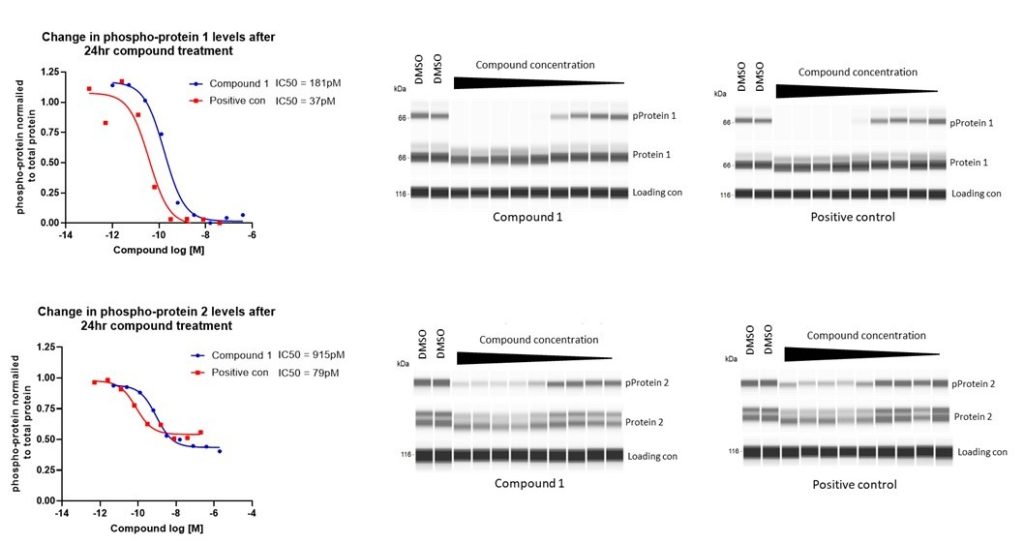


In our study, we employed JESS automated western blotting to monitor the levels of various phospho-proteins along a signaling pathway. This continuum allows scientists at monitor the pharmacological activity of novel drug compounds using a single assay throughout its development journey.
Biomarkers serve as measurable indicators of normal biological processes or pathological states. They are crucial in evaluating the efficacy of new drug molecules and significantly enhance the success rate of therapies advancing to clinical trials. A major advantage of biomarkers is their applicability from in vitro cell-based screening assays through in vivo animal models to clinical samples. This continuity allows scientists to track a novel drug compound using a single assay throughout its development journey.
Biomarkers, being highly specific disease markers are instrumental in assessing compound potency and specificity. For instance, phosphorylation of cell signaling molecules is a pivotal biomarker. Post-translational protein modifications, such as phosphorylation, alter protein activity, localization, and stability, playing a critical role in modulating signaling cascades.
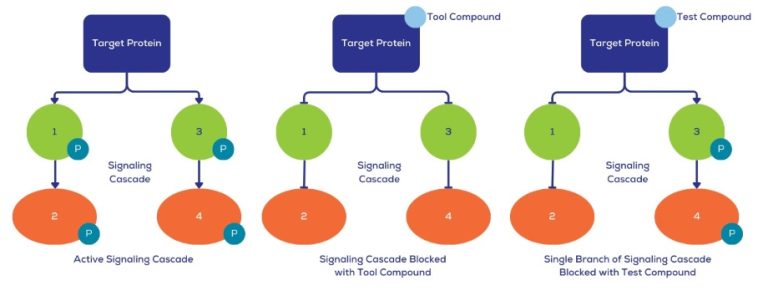
The target protein is part of a complex, multi-branch signaling cascade. Our project aimed to develop an inhibitor that specifically targeted one branch of this cascade. Existing commercial drugs, although potent, lack specificity and inhibited multiple pathways, leading to unwanted side effects in patients and limiting the treatment’s duration and dose.
Our goal was to create a screening cascade to rank compounds based on potency and to demonstrate compound specificity. We developed an assay to measure the levels of multiple phospho-proteins, serving as biomarker readouts for compound activity and specificity. The challenge was to identify compounds that precisely targeted one branch of the signaling pathway without affecting others.
We utilized automated western blotting to monitor the phosphorylation status of proteins that are sequentially phosphorylated within a signaling pathway. The initial screening round employed a knockout HEK293 cell line, focusing solely on the primary on-target phospho-protein. This single readout approach increased assay throughput, allowing us to efficiently narrow down the list of optimal compounds before advancing to more detailed screening assays.
Once a lead group of compounds was identified, they progressed to testing in a biologically relevant cell line susceptible to the off-target effects of the tool compound. This second screening stage assessed compound potency and specificity by monitoring multiple phospho-protein targets.
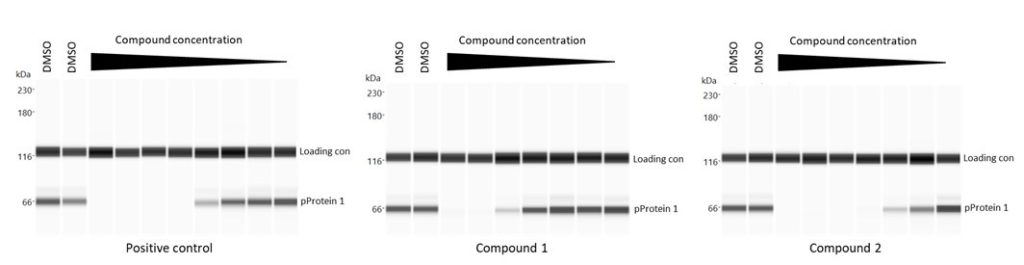
The first stage of the screening pathway involved monitoring protein phosphorylation in an engineered HEK293 cell line with a target gene knockout. This knockout upregulates the signaling pathway, providing a robust background to assess compound activity. Jess automated western blotting, known for its sensitivity, reproducibility, and visual data output, was used for biomarker detection.
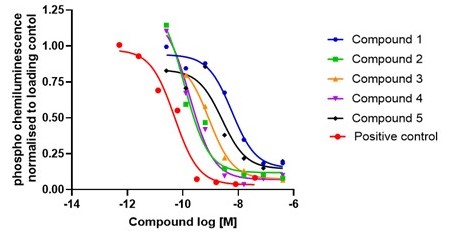
HEK293 cells were treated with a half-log dose response of each compound for 24 hours. During cell lysate preparation, special care was taken to preserve phosphorylated proteins before running the samples on JESS. A control compound was included in every assay for comparison.
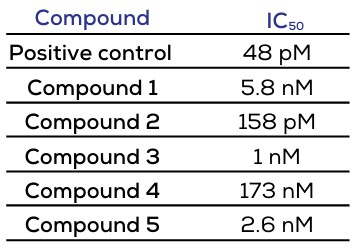
Compounds were ranked based on their IC50 potency, and this data was used in the design-make-test-analyse cycle with the chemistry team to drive further iterative synthesis and enhance compound potency.
Once a group of lead compounds was identified, the assay was transitioned to a more biologically relevant cell line susceptible to the compounds’ off-target effects. To gain a comprehensive understanding of the compounds’ effects in the cells, we expanded the number of biomarkers analyzed to include two from the specific pathway and two from the nonspecific pathway.
The tool compound causes a decrease in phospho-proteins along both branches of the signaling cascade, while the test compounds should specifically target only one branch. Cells were treated as before, but the dosing range was increased to generate more accurate IC50 curves.
This assay allowed us to confirm that our test compounds differed from the market leading drug and were specific to the signaling cascade branch of interest.
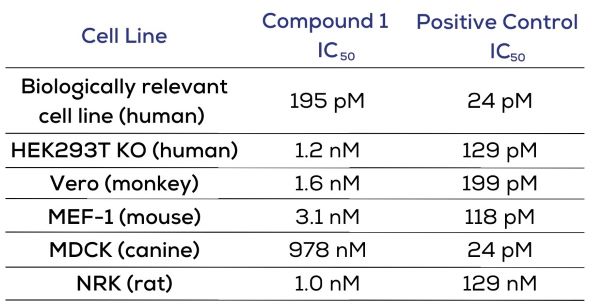
When transitioning compound screening to in vivo studies, it is crucial to ensure that the signaling pathway of interest remains active in the selected animal model. Subtle differences in gene expression and protein levels across species may impact a new drug’s potency and specificity. In our study, we screened the top three compounds in animal cell lines from four different species commonly used for initial in vivo work (mouse, rat, dog, monkey).
Our objective was to compare the potencies of the lead compounds between the human cell lines used in the initial screen and these animal cell lines. We discovered that the compounds were active in all the animal cell lines, albeit with reduced potency. This observed drop in potency between human and animal cell lines informed the dosing range to be used in the selected animal model, ensuring appropriate translation of results from in vitro to in vivo studies.
From the same category: